


How to choose church management software is a decision most Ghanaian churches make once every five or seven years, which is why so many committees get it wrong. Nobody on the team has done it before, every vendor sounds credible, and the pastor is busy.
Last year I sat with the committee at Faith Harvest Chapel in Accra: a main auditorium on the Spintex road, branches at Madina and Tema Community 25, about 1,100 people across three Sunday services, and a separate exercise book in every branch. They had four months of frustration and two demos booked. We ran the process below in six weeks and signed in week seven.
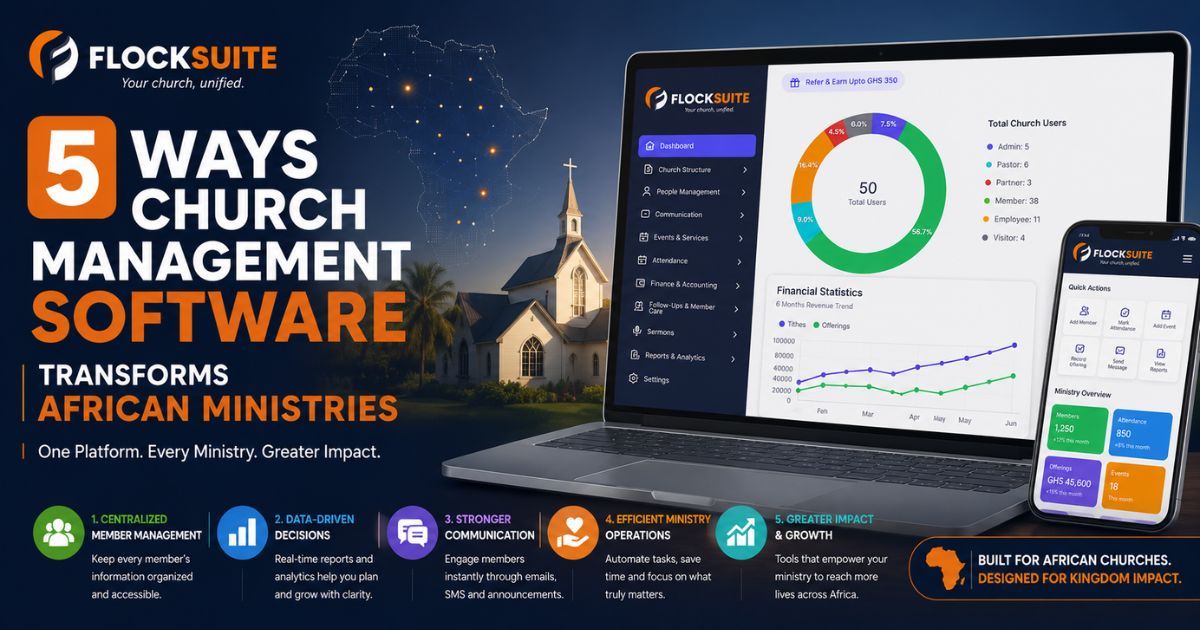
Before the first meeting, it helps to see how a real church platform is laid out. A free FlockSuite trial takes ten minutes and gives the committee a reference point that is not a slide.
How to choose church management software starts with a committee, not a demo
Vendors demo well. A competent salesperson can make a thin product look complete for forty minutes, and a committee without written requirements will judge on polish.
Who belongs in the room
- The administrator or secretary, who knows where the records break.
- The treasurer, because giving reconciliation is the requirement vendors handle worst.
- One branch pastor, who knows whether the head office view matches the ground.
- The Sunday data entry volunteer. If a task takes more than a minute on a phone, the product is dead.
- One outsider, ideally a banker or auditor, who asks what insiders are too polite to ask.
Five to seven people. More than that and the meetings become a parliament.
Agree a decision rule before anyone has a favourite
- The pastor does not chair. A committee chaired by the person everyone wants to please agrees with whoever spoke last.
- No vendor presents until the requirements sheet is signed off.
- A decision needs four of five votes, with reasons in the minutes.
- Anyone with a financial interest in a vendor declares it and leaves the room.
That last rule sounds obvious until a church spends six weeks arguing over a product sold by a member's brother-in-law.
Write down the real requirements before anyone shows you a product
A feature list is marketing. A requirement is a sentence you can test in a demo.
Turn last month's complaints into requirements
For two weeks, keep an incident log. When something goes wrong, write the sentence that starts with "if only". If only we knew which of the 6am people also come on Wednesday. If only the ushers' count matched the treasurer's figure. Those sentences are your requirements, and a vendor cannot argue with them the way they argue with a checklist.
The five requirements Ghanaian churches almost always share
The Church of Pentecost reported 20,230 assemblies in 1,804 districts across 84 areas in Ghana by December 2025, per its official statistics. Structures that size do not buy the way a three branch church does.
| Requirement | What to write down | How to test it |
|---|---|---|
| Attendance by service | Named attendance for 6am, 9am and 11am at each branch, children separate | Ask for the trend and the service breakdown, live |
| MoMo reconciliation | Match MTN MoMo and Telecel Cash receipts to members weekly, with reference code and sender name | Hand over twenty real receipts and ask them to post them |
| Branch roll up | One consolidated attendance and giving report, each branch pastor seeing only their own giving | Add a branch and produce the consolidated figure |
| SMS to members | One message to 1,100 numbers, delivery failures visible, opt outs honoured | Ask the price per SMS in cedis and a delivery report |
| Offline tolerance | Record attendance and offering with no network at 6am, sync later without duplicates | Switch off the wifi and show you |
Mark each one must have or nice to have
A must have is something the church cannot run without by the end of the first quarter. Be strict, because this column decides the outcome.
Score every option the same way
Weighted scoring sounds like something from a bank, but it forces the committee to decide what matters before it knows who wins.
Set the weights before the demos, then leave them alone
Give each requirement a weight out of 100 and score each product from 1 to 5. Multiply the weight by the score and divide by five. Giving has moved too: the Bank of Ghana recorded GH₵518.8 billion in mobile money transactions in August 2026 across 26.4 million active accounts, per its fintech statistics. A product that treats mobile money as a side channel is behind your church already.
| Criterion | Weight | Vendor A | Vendor B | Vendor C |
|---|---|---|---|---|
| Attendance by service | 20 | 5 | 4 | 3 |
| Giving and MoMo reconciliation | 25 | 4 | 2 | 4 |
| Branch roll up and permissions | 15 | 5 | 4 | 2 |
| SMS and communication | 15 | 3 | 4 | 4 |
| Offline behaviour | 15 | 2 | 4 | 1 |
| Three year cost | 10 | 4 | 5 | 5 |
| Weighted score | 100 | 78 | 72 | 63 |
The arithmetic is simple enough to check on paper, and a treasurer who sees where 78 came from will trust it.
A high total does not beat a failed must have
Vendor A wins on paper with 78 and should still lose, because it scored 2 on offline behaviour while the church had set a floor of 3 on every must have. Faith Harvest chose Vendor B at 72, on condition that MoMo reconciliation ran by weekly CSV import until a direct integration shipped.
Write the floor rule into the sheet before scoring: any product below 3 on a must have is disqualified, whatever its total.
Nothing calibrates a committee faster than a real product. Start a free FlockSuite trial and hand the login to the Sunday data entry volunteer, not the pastor.
Demo questions that expose weak products
There are two kinds of demo. In the first, the vendor presents slides. In the second, the vendor logs in and answers on the spot. Only the second tells you anything.
Send the script a week ahead and refuse changes
Give every vendor the same six tasks and forty five minutes, and tell them the committee scores immediately afterwards. If they ask to walk you through the platform instead, that is your first data point.
Six tasks that separate products from slideware
- Show attendance for the 9am service over the last eight weeks, then the 6am service on the same screen.
- Here are twenty mobile money receipts from last Sunday. Post them to the right members and show the batch total against the offering count.
- Add a fourth branch now, then show the consolidated attendance for last month.
- Send a test SMS to this phone, then show the delivery report and the opt out list.
- Switch off your wifi, record ten attendances and an offering, switch it back on, and show me the sync.
- Export every member record to a file I can open in Excel, and tell me how long that takes.
Task five clears the room. Offline capability often means the app caches a page, not that it records a full service with no signal and syncs without duplicates.
Red flags worth ending an evaluation for
- The presenter cannot log in without a colleague joining the call.
- The demo data is a tidy church of 200 where nobody gives by mobile money.
- They cannot quote a price per SMS in cedis, only "credits".
How to choose church management software when the references disagree
Every vendor has three happy customers. There are enough churches in Accra alone for any supplier to assemble a flattering list, so a reference check is only useful if you control which church you speak to.
Ask for a church your size, with your structure
Request two references with similar attendance and branch count, and one that has been live for over a year. If the vendor cannot produce a three branch church of 800 to 1,500 people, that silence is an answer. A church of 90 in one hall cannot tell you how the system behaves when three offerings land at once.
Three questions that get past the script
- "What did you stop using after three months?" Every church abandons part of the product, and the answer names the weak module.
- "Who enters the attendance, and how long does it take on a Sunday?" Then speak to that person, not the administrator.
- "What did the first month after go live look like?" You are listening for whether the vendor did the migration or left it to the secretary.
Call the treasurer separately with one more question: did the giving figures match your old records in the first quarter? A pause is an answer.
Data migration and exit terms belong in the contract
Two clauses decide whether this purchase is a tool or a trap. What happens to your data when you leave, and who may touch it while you stay.
What to demand in writing before you sign
- A full export of members, families, attendance, giving and message history in CSV or Excel, on request, at no charge. Giving history in detail, not annual totals.
- A named migration owner and a date. "We will help you import" is not a commitment.
- Notice period, and written confirmation of what happens to the data after cancellation.
- The price for year two and year three, in cedis, not "subject to review".
- Who can see giving records, and whether a branch pastor can see another branch's figures.
Ghana's Data Protection Act, 2012 (Act 843) makes your church the data controller, not the software company, and section 27 requires data controllers to register with the Data Protection Commission. The church, not the vendor, is answerable for a member's phone number and giving history. Ask where the data is hosted, who can access it, and whether the vendor will sign a processing agreement.
Test the migration before you pay, not after
Take 200 real member records, including the messy ones, and ask for them to be loaded into a trial. Count how many arrive with a phone number the system can actually use. Ghanaian numbers appear in five formats in the same register, and a product that stores them as free text will break your SMS delivery quietly. FlockSuite's pricing page lists SMS credits per plan, the line item most committees forget.
Pilot one branch before you roll out
Every vendor offers a trial. Very few churches run a pilot, which is a different thing. A trial is a login. A pilot has a pass mark and a date.
Set the pass mark before the first Sunday
Faith Harvest ran Madina for four Sundays against five numbers agreed in advance:
- 95% of Sunday attendance entered by 6pm the same day.
- Every mobile money receipt matched to a member, or marked unknown, by Tuesday.
- SMS delivery above 90% of messages sent.
- No Sunday lost to network or power failure.
- Two people, not one, able to complete the whole Sunday routine.
Read the failure correctly
If the pilot fails on data entry, the product may be fine and your process is not. Fix the process before blaming the software. If it fails on reconciliation, the product is wrong for your church, however good the demo was. Roll out to the other branches only after two clean Sundays, and train the second branch team on live data, never a demo account.
Six weeks for a three branch church in Accra
What each week produces
Ninety minutes a week, with the pastor available for two of the six meetings.
| Week | What the committee does | Output |
|---|---|---|
| 1 | Form the committee, agree the decision rule, open the incident log | Named committee, one page rule |
| 2 | Write requirements, sort must haves, agree weights | Signed requirements sheet |
| 3 | Shortlist three vendors, send the demo script | Three demos on one script |
| 4 | Run demos, score each one the same afternoon | Completed scoring sheet |
| 5 | Reference calls, contract redlines, migration test | Two references checked |
| 6 | Pilot plan, training dates, pass marks | Pilot start and go no go date |
Whichever product you shortlist, the committee's real deliverables are three documents: a requirements sheet, a scoring sheet and a pilot with a pass mark. Start a free FlockSuite trial to have a working product beside you while you write them. For the wider picture, read the complete guide to church management in Ghana. If branch reporting is your headache, how to manage multiple church branches goes deeper, and the attendance tracking guide will sharpen your first requirement.
Frequently asked questions
How long should it take to choose church management software?
Four to six weeks for a church with two or three branches and a weekly committee meeting. Anything faster means the requirements or references were skipped. Anything slower usually means nobody agreed a decision rule.
What should a Ghanaian church budget for church management software?
Expect GH₵150 to GH₵500 a month for most Ghanaian churches of 300 to 3,000 people. FlockSuite's own plans run from GH₵150 for 300 users to GH₵500 for 3,000. Add SMS credits, usually the largest variable cost, and your own staff time for migration.
Should we just buy what our denomination recommends?
Only if the recommendation comes with a reference church your size and a written price. A denominational endorsement is a starting point for a shortlist, not a procurement decision.
What if the committee cannot agree?
Check whether the disagreement is about facts or preferences. If two products pass every must have and score within five points, choose the one whose reference church looked most like yours, and record the tie break in the minutes.


Comments
No comments yet. Be the first to share your thoughts!
Leave a Comment